

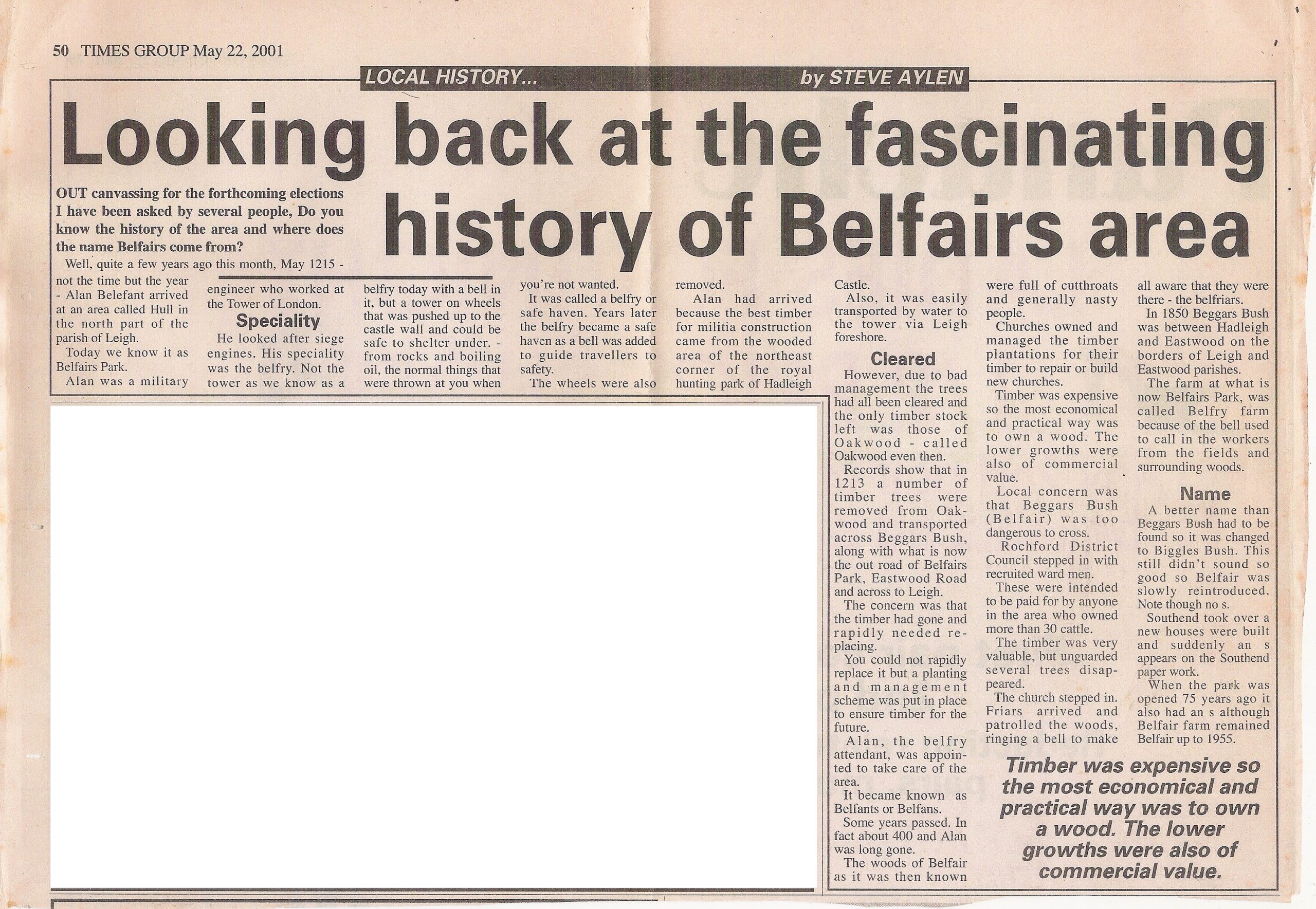
22nd May 2001 saw the publication of Steve Aylen’s article on the origin of the name Belfairs; a copy of which is reproduced here.
Summary based on Mr Aylen’s article:
Where does the name Belfairs come from? In the early 13th century, Alan Belefant arrived in the area called Hull* in the north of the parish of Leigh. Alan was a military engineer who worked at the Tower of London. His speciality was the belfry, a tower on wheels that was pushed up to the castle wall as a relatively safe shelter from the weapons of castle defenders. It was called a belfry or safe haven. {Later the belfry had wheels removed and a bell added to guide travellers to safety.}
Alan the engineer wanted the best timber for military construction, and the best had come from the wooded area of the northeast corner of the royal hunting park of Hadleigh Castle. However, the best trees had been cleared from there and the only suitable stock left was in Oakwood. Records from 1213 show a number of timber trees were taken from Oakwood via Eastwood Road to Leigh for water transport to London. To replace the felled timber, a planting and management scheme was put in place. Alan the belfry attendant was appointed to take care of the area, which over time became known as Belfants or Belfans. After several centuries, the woods became known as Belfair and were used by unsavoury folk; making it known as Beggars Bush.
Churches needed expensive timber to repair existing buildings or build new ones and the most economical and practical way was to own a wood. Friars patrolled the woods ringing a bell to advertise their presence – becoming the belfriars.
Belfares, later Belfair Farm was in the area between Hadleigh and Eastwood, it called workers in from surrounding fields and woods using a bell. The farm’s name stayed Belfair up to 1955 but when new houses were built, the name Belfairs appeared on Southend paperwork.
{Ed: * Hull Grove was between Goldingsley Grove and Wood (all three destroyed around 1938 to become a golf course) and Little Birches Wood (destroyed for housing 1939-59) … reference “The Woods of South-East Essex” by Oliver Rackham, 1986. }
No Comments
Add a comment about this page