
A widowed member of early 19th century London`s social elite was the generous benefactor who provided educational improvement for the poor of the parish of Hadleigh. Martha Lovibond was a very important figure in 19th century Hadleigh although her residence in the village was relatively brief. Thanks to her philanthropy, Hadleigh was provided with its first solidly financed parish school aimed at the poorest children1. {More about the school.}
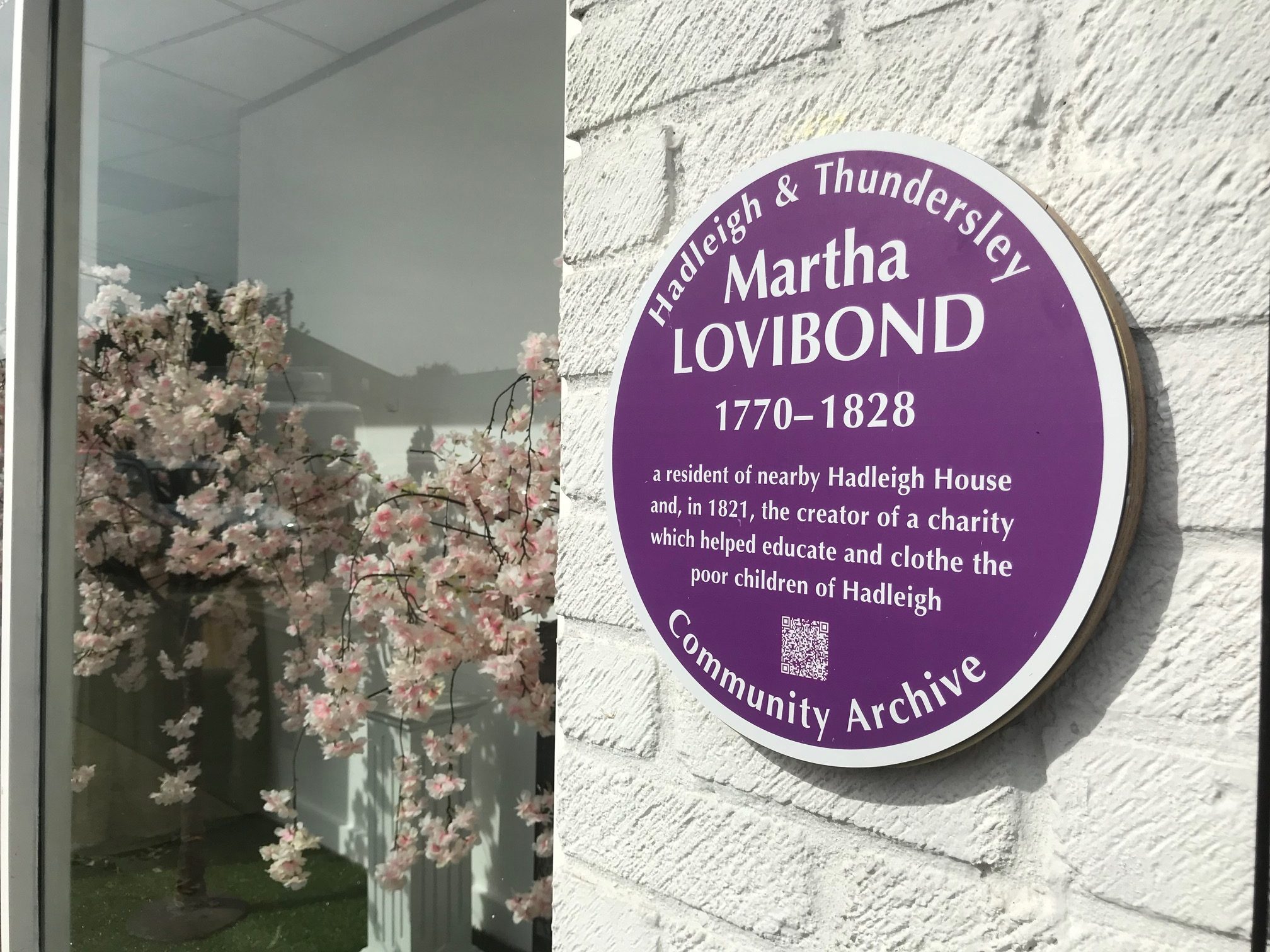
Martha Lovibond of Hadleigh House, plaque installed August 2024
In the Morning Post of 3rd February 1815 readers discovered, “Mrs Lovibond gives a ball and supper on Wednesday next, the 15th of February.” This notice comes towards the end of a long list of social engagements of the titled, the rich and the famous. Martha Lovibond was the daughter of a famous judge and had married a man of considerable wealth and family connections. Hence her inclusion in the social calendar.
Martha was born Martha Impey in 1770, one of the ten children of Sir Elijah Impey (1732-1809), a judge and later an MP. Her father`s main claim to fame lies in the tale of the controversial impeachment of Warren Hastings. Impey as Chief Justice in the court in Calcutta and Hastings were lifelong close friends and were both involved in the case of the Maharajah Nandakumar who was hanged for forgery and robbing a widow. Both Hastings and Impey were impeached for conspiring to commit a judicial murder but later were officially cleared of guilt in this matter with Impey being praised for his fairness.
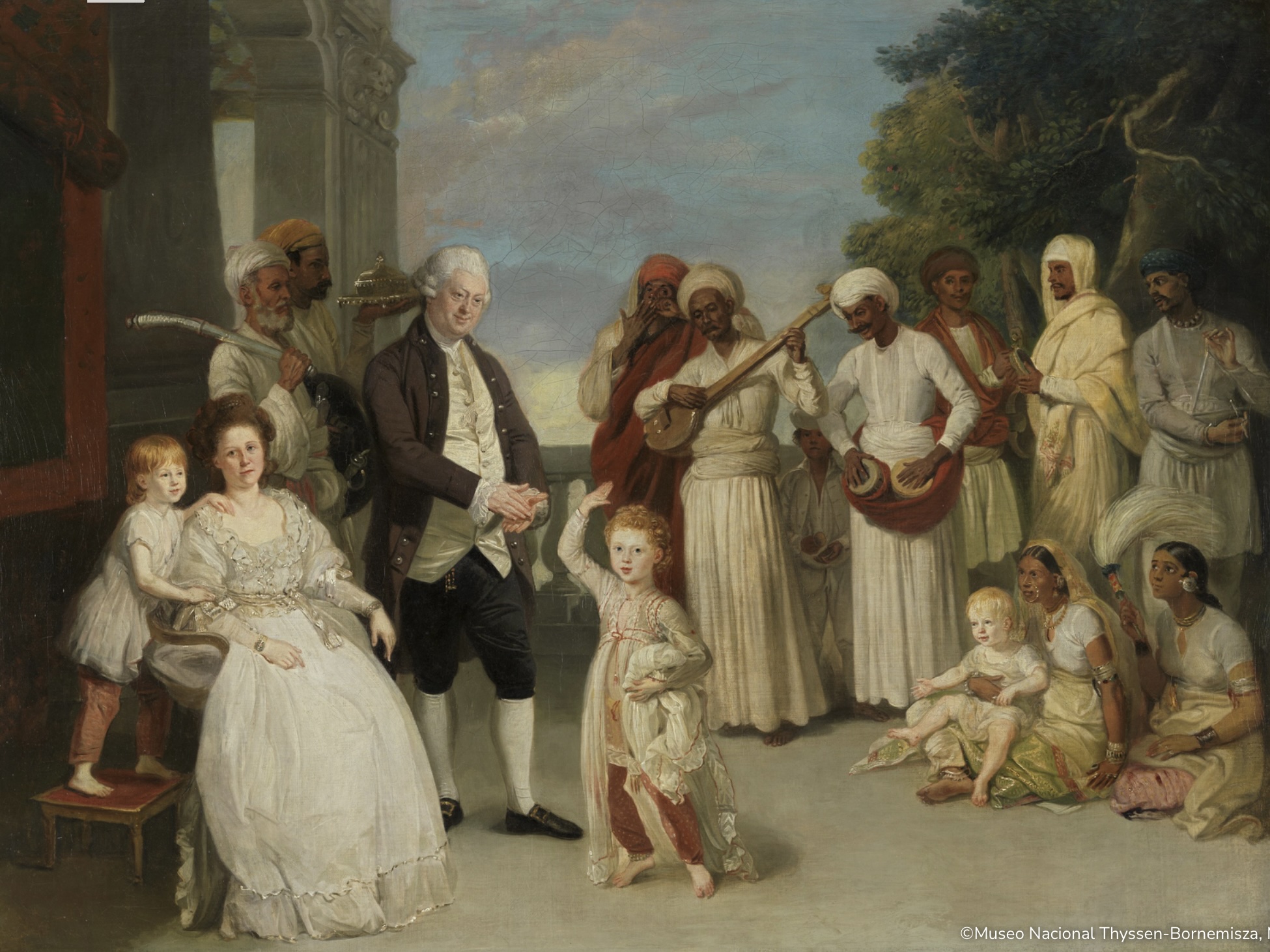
The Impey Family and household
Martha married George Lovibond in 1793. He was 13 years older than her. They lived in a variety of places including Hatfield Peverell, Essex, and had a town house in Manchester Square, London. George died in 1817 leaving Martha a widow with two children. In the following year she also lost her daughter, Harriet Catherine, aged 21, at Funchal in Madeira to which the family had temporarily retired soon after the death of George. Perhaps it was the second death that drove Martha and her son, George, back to England. Why Martha chose Hadleigh we do not know but she became resident in Hadleigh House. When she arrived is not known but she had certainly left Hadleigh by August 1821. From her subsequent actions it is clear that during her stay in Hadleigh she saw enough poverty and ignorance to provide her with the impetus to make generous provision for the children of the poorest inhabitants of the village.
The Curate of Hadleigh in August 1821 was John Squire who, helpfully for us, left the following note in the Hadleigh parish register:
“In the year of our Lord 1821 Mrs Martha Lovibond, formerly a Resident of this Parish very munificently gave in her life-time the sum of £750 4% Stock – producing £30 per ann: for the purpose of educating and clothing the poor children of the parish, appointing the Archdeacon of Essex and the Rector, Trustees for ever of the said Charity, at the same time like a true Xtian declining to have her name introduced by being painted on the walls of the church or otherwise – But that so excellent an example might not be altogether lost, the present Curate has thought it fit to insert this Memento.
John Franklin Squire Hadleigh August 4th 1821
£750 was an extremely generous amount of money and clearly the gift of a woman who genuinely wished to make a difference and not the offering of someone who wished merely to impress. Her reluctance to be named also did her great credit. In the previous year Martha had also given generously in her old home, Hatfield Peverell. Here she provided almshouses for old people,
“built and endowed by Martha Lovibond in accordance with the wishes of her deceased daughter Harriet Catherine Lovibond.”
These houses, known as Lovibond Cottages survive today and are Grade II listed buildings. The charity is still registered today to assist those over 60 who have close ties with the town. Sadly, the Hadleigh charity was de-registered by the Charity Commission in September 1997. The Commissioners` website records the charity as “Funds spent up”. The initial 4% stock had been reduced to 3% consols in November 1824.
Martha`s generosity was undoubtedly welcomed by many but it caused her considerable anxiety from time to time. In 1824 her brother, Elijah, a close friend of Hugh Jones, the Archdeacon of Essex, wrote to his friend in support of Martha who had already written to the Archdeacon with several complaints. These included the falling of attendance numbers from 80 to 20, the incompetence and idleness of the current teacher and children deliberately attending close to Christmas just to obtain clothes to the disadvantage of those attending regularly2. Some changes were made but this was the first of several problems partly created by the absenteeism of the Rev Mavor and his complete lack of interest in what was happening in Hadleigh or his duties as a trustee of its school3.
In 1841 an inspection by the Rev. Robert Eden had interesting results: notice was given to the schoolmaster, he was replaced by a schoolmistress and the school was to be open every day of the week. Despite Rev. Mavor’s scorn that it was hopeless to expect a woman to control the children, things began to run smoothly with the schoolmistress assisted by paid assistants and a basic monitorial system in operation. By the late 1840s thanks to Sarah Ann Baldwin, the butcher’s wife, the Lovibond school was very successful and popular at the Baldwin’s house until it was replaced by the new National School in 1855.
Martha never had the opportunity to see her school at its most successful because she died at Tunbridge Wells on 11thAugust 1828, aged 58. She is remembered along with her husband and son on a family monument in Hatfield Peverell`s parish church.
Footnotes
1. A number of schoolmasters were licensed by the church in the 17th century. The first in Hadleigh was George Lovell in 1662. My thanks to Lynda Manning for providing this information from her on-going research into the Clergy of Hadleigh. A document at the ERO [TS 453/1] tells us that in 1808 a return was made to the Archdeacon of Essex with regard to education in Leigh and Hadleigh. In the latter village was one school of some 15 scholars whose curriculum was only reading and needlework.
- See correspondence at the ERO relating to Hadleigh School 1824-1868 [D/AE M1/1/9]
- For further information about John Mavor, the absentee rector, see the article Fall and Rise of Hadleigh Rectory 1825-1868 Part 1
AUTHOR`S NOTE
I have discovered no portrait of Martha Lovibond. One may exist. There is a large group portrait of Sir Elijah Impey`s family by Zoffany but it is not possible to tell if Martha appears on it. This is the link to a brief article about the picture by Zoffany.
Comments about this page
Add your own comment
Mrs Lovibond’s philanthropy also extended to the financial needs of musicians (and their families) in distress.
From the Minutes of the Royal Society of Musicians Governors Meeting for 3rd March 1811:
“Mr. Blake* gave in the names of Mrs. Lovibond and Miss Harriet Lovibond 23 Manchester Square as Honorary Members”.
*Benjamin Blake was a Member of the Court of Assistants of the Society.
Add a comment about this page