
Sir Charles Nicholson (1st Baronet of Luddenham)
An elegant History Plaque has been installed as a memorial in Hadleigh

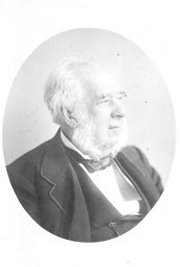
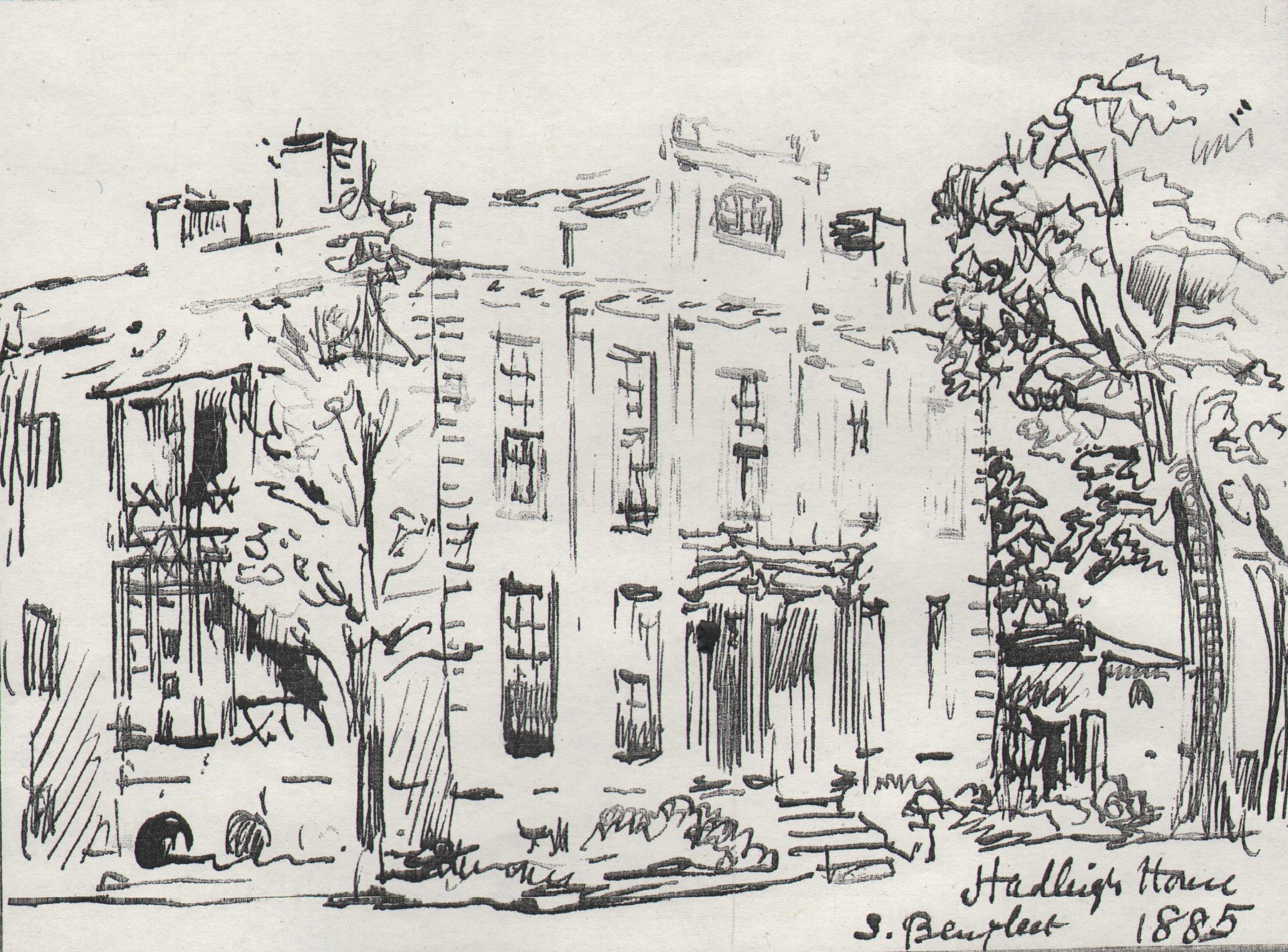
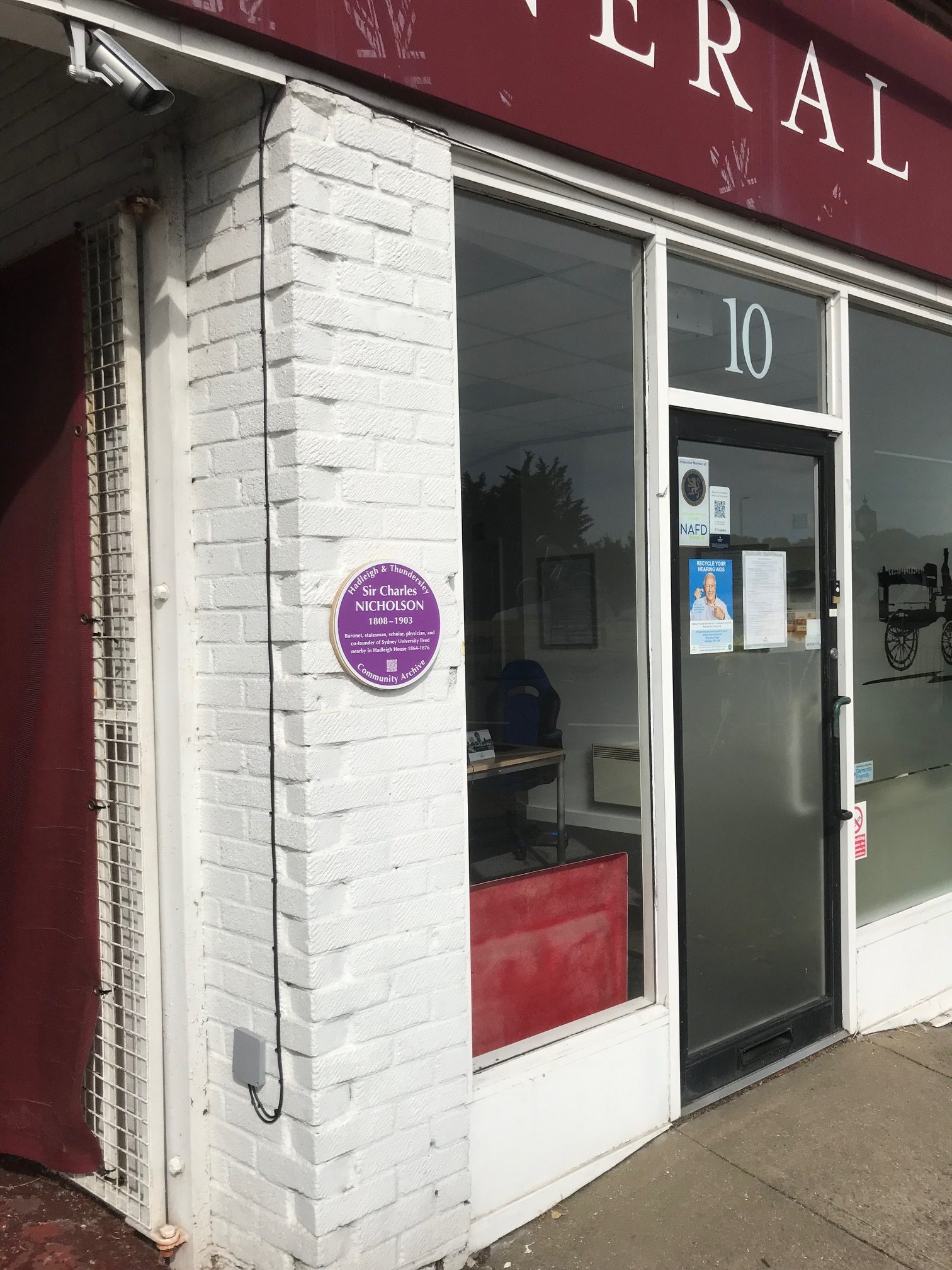
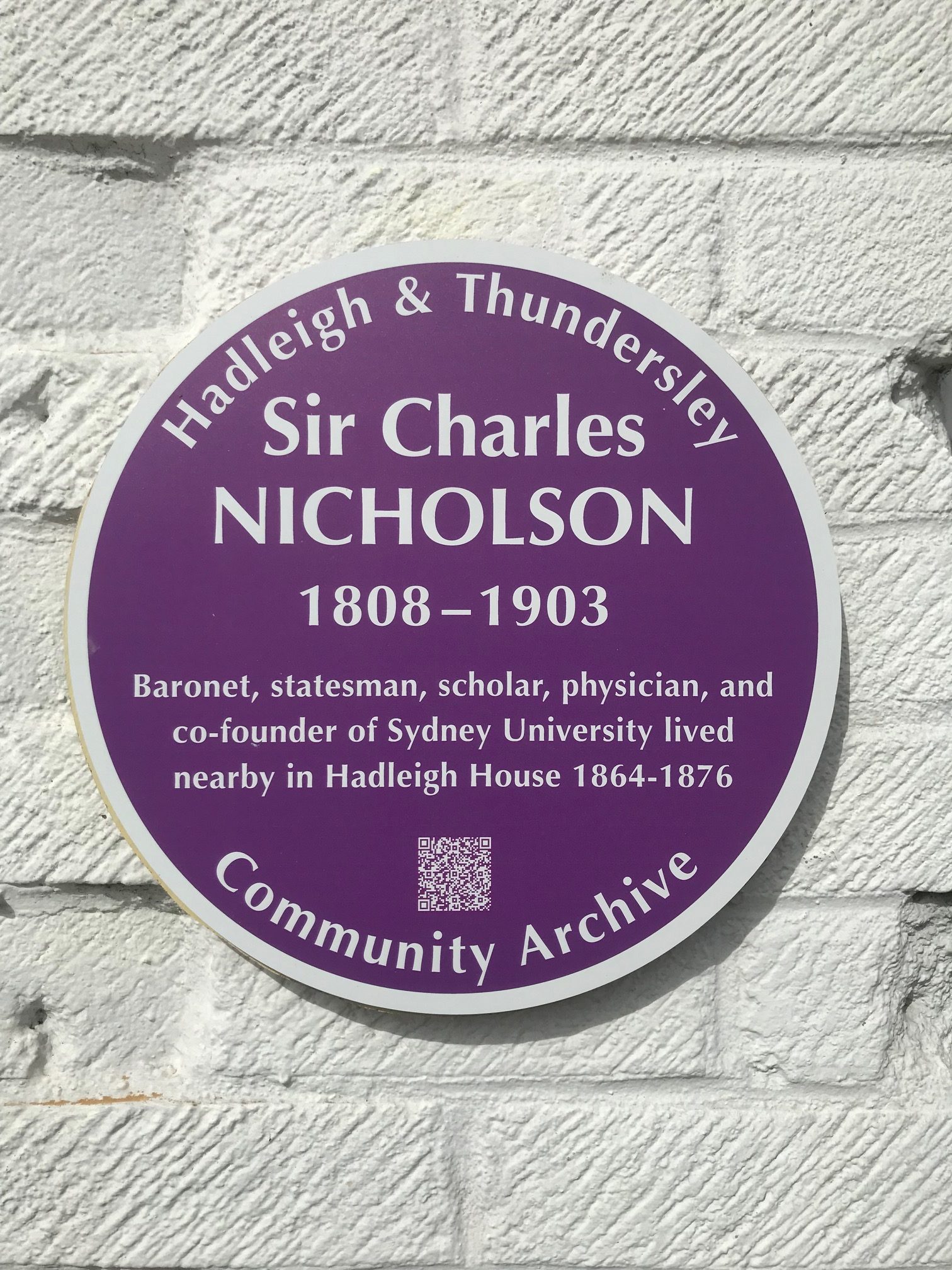


It is extraordinary that Sir Charles Nicholson (1st Baronet of Luddenham) is not better fêted in Castle Point. A couple of roads (which abut the site of his old estate) are named for him, but that is all. Perhaps it is because his most illustrious achievements – and fame and fortune – were made on the other side of the world. He was, without doubt, one of the great figures of 19th-century Australia: doctor, explorer, patron of the arts, educationalist and politician. He founded the University of Sydney and became the Speaker of the New South Wales Legislative Council (for which he was knighted in 1852) before being created Australia’s first baronet in 1859.
Nicholson’s roots are shrouded in mystery – he was born illegitimate in 1808 as Isaac Ascough, to a well-to-do lady in Cumberland and suffered an identity disguising name-change by the time he gained his medical degree from Edinburgh. Shortly before his twenty-fifth birthday he sailed to Botany Bay as a convict ship’s surgeon. Once there he established a medical practice (as a gynaecologist and obstetrician) and, in 1843, after inheriting his uncle William Ascough’s wealth and becoming successful in various businesses, he became a founder member of the Legislative Council of New South Wales (later, the Speaker) and Chancellor of the University of Sidney.
Nicholson returned to England’s shore in 1862 as a Baronet, having been away nearly 30 years. He never returned to Australia but maintained a professional interest in it as a consultant to the British Government. He was given the honorary degrees of D.C.L. by Oxford, and LL.D. by Cambridge and Edinburgh universities.
Nicholson died in England on 8 November 1903, a fortnight before his ninety-fifth birthday.
Sir Charles took up residence at Hadleigh House in 1864 at the age of 55. He married Sarah Elizabeth Keightley the following year and Hadleigh House remained the family home for the celebrated couple and their growing family until 1876.
There is no trace nowadays of Hadleigh Great House (later renamed Victoria House) but a magnificent Wellingtonia redwood tree which stood in its extensive gardens stands testimony to a grander age. More on this beautiful tree is available here.
The house had been built in the Regency style at the beginning of the nineteenth century and, although it still looked palatial a century later, its accommodation was hardly fit for the gentry it was designed for.
Their three sons: Charles Archibald b.1867, Archibald Keightley b.1871 and Sydney Hugo b.1875 all went on to achieve national eminence in their own right: Charles (2nd Baronet) became a highly respected ecclesiastical architect, Archibald became a much-feted stained glass artist (local examples of both brothers’ work at St Mary’s, South Benfleet and St Alban’s, Westcliff) and Sidney – one time organist at Westminster Abbey – was knighted for services to church music (principally for founding the Royal School of Church Music).
Sir Charles Archibald Nicholson, 2nd Baronet of Luddenham, spent his formative years living at Hadleigh House and, although he loved the gardens, he described the house as inconvenient, damp and insanitary.
No Comments
Add a comment about this page